
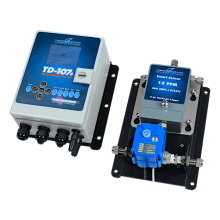
The TD-107s is smaller, lighter, and offers a modular remote detection cell that makes maintenance and exchange easy. Pre-calibrated cells are available for simple swap-out by the end-user via plug-and-play connection...

Oil Content Monitors
Fluorescence Oil Content Monitors
IMO MEPC 107(49) Certified
The TD-107 Fluorescence Oil Content Monitor (OCM) is a 15 ppm bilge alarm for oily water separators based on UV fluorescence detection technology. Fluorescence occurs when a molecule absorbs light energy of one specific wavelength and emits light energy of a longer wavelength. Fluorescent compounds (such as oil) each have a unique UV wavelength signature, and these compounds can be detected as an actual concentration of oil in water. Fluorescence makes the TD-107 resistant to interferences by turbidity or particles/sediments in the bilge.
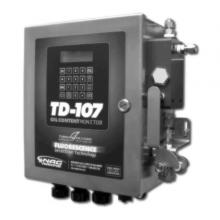
(Discontinued - Service Only)
Individual units & replacement parts in finite supply.
The TD-107 Fluorescence Oil Content Monitor (OCM) is a 15 ppm bilge alarm for oily...

NAG Marine's mission is to provide best-in-class products and technical representative services to our highly valued customers. We focus on technological solutions to difficult problems in the Fluid Automation and Shipboard Computer markets.
NAG News

Post date: 27 Aug 21
Norfolk, Virginia. (Aug. 25, 2021) – Local company, NAG Marine, celebrated today the ceremonial first cut of steel for t... Read More

Post date: 22 Mar 21
Norfolk, VA
February 4, 2021
NAG Marine, Norfolk, Virginia, has partnered with DASPOS International Inc. in it... Read More

Post date: 15 May 20
Overview:
Everyone recognizes the hum of a computer. The wheels clicking and noises of discs spinning are a fam... Read More

Post date: 15 May 20
The Current Cyber Environment:
A study by the University of Maryland in 2019 showed that a hacking attempt is r... Read More
© 2024 NAG LLC | Privacy Policy | Terms & Conditions